On 09 Feb, 2019
 I never thought a recent family vacation to see the full solar eclipse in 2017 and geysers at Yellow Stone National Park would be as cool as it turned out to be. My family and I planned a trip in a packed 8-passenger minivan. Every seat was filled: two adults in the front, one being pregnant; 6 kids, 8 years old and younger in the back. (Phew! Call us crazy, and we didn’t know what to expect, but those kids were extremely well behaved, and I don’t think we had one tantrum during the whole trip.) There wasn’t room for much else in the van, but my wife, Dawn, miraculously, got everything we needed for a 10-day trip to fit into every nook and cranny of that reliable van. That is a special talent she has.
We drove over 900 miles from Apache Junction, Arizona to Rigby, Idaho, to witness the full solar eclipse back in August, 2017. During the full solar eclipse I felt like I was in some sci-fi movie. It was totally unreal.

Although it was the highlight of our trip, that’s not what I wanted to focus on. After having my own personal witness of the full solar eclipse, we took the long way home by heading Northeast to Yellowstone National Park. I wanted to see the geysers there first hand.
Why did I even want to go see these geysers? I never really cared before. I would sarcastically think to myself, “Yeah! Water just shot out of the ground. Great!” Now I am fascinated by one of the first new natural laws that is presented in Volume I of the Universal Model, the Gravitational-Friction Law.
The Gravitational-Friction Law
Basically, there are processes happening on Earth of which I was totally unaware. I know that there are ocean tides that come in and go out because of the gravitational pull of the Moon and Sun. However, I never knew that they were also pulling on the crust of the Earth. The ground we stand on goes up and down, depending on where you live, about 12-18 inches everyday. It is so subtle that we don’t feel it happening. I found a website that shows, in real time, the measurements of the movement of the crust as the Sun and Moon pass over. It’s pretty amazing to see.
All of this movement, as subtle as it may be, is what drives our weather. That’s another important concept to talk about. For now, let me say that all this movement is causing friction in the Earth’s crust.
If you lightly rub your hands together you will begin to feel some heat from the friction. If you push your hands together hard and rub them fast, you will feel an increase in the temperature almost immediately.
Similarly, Earth tides are heating the crust of the Earth by their movements. Although this is happening all over the world, there is much more frictional heating going on in Yellowstone National Park. Today we are taught that Yellowstone is sitting on top of a “supervolcano” that is doomed to erupt some day, possibly soon. That idea is a pseudotheory, i.e. a false theory taught as fact. There is no supervolcano below Yellow Stone National Park. Magma plumes, thought to be volcanic centers, don’t exist. There is no magma in the center of the Earth. Instead, it is frictional heating that is causing underground water to erupt as geysers in Yellowstone.
A Spectacular Show
Old Faithful was faithful as usual. We showed up just in time to find a seat and watch Old Faithful erupt superheated liquid water and steam. It’s quite spectacular from a bench a mere 300 feet away when it’s shooting water 90-180 feet in the air. The opening of its cone is an oval about 3 feet by 7 feet.
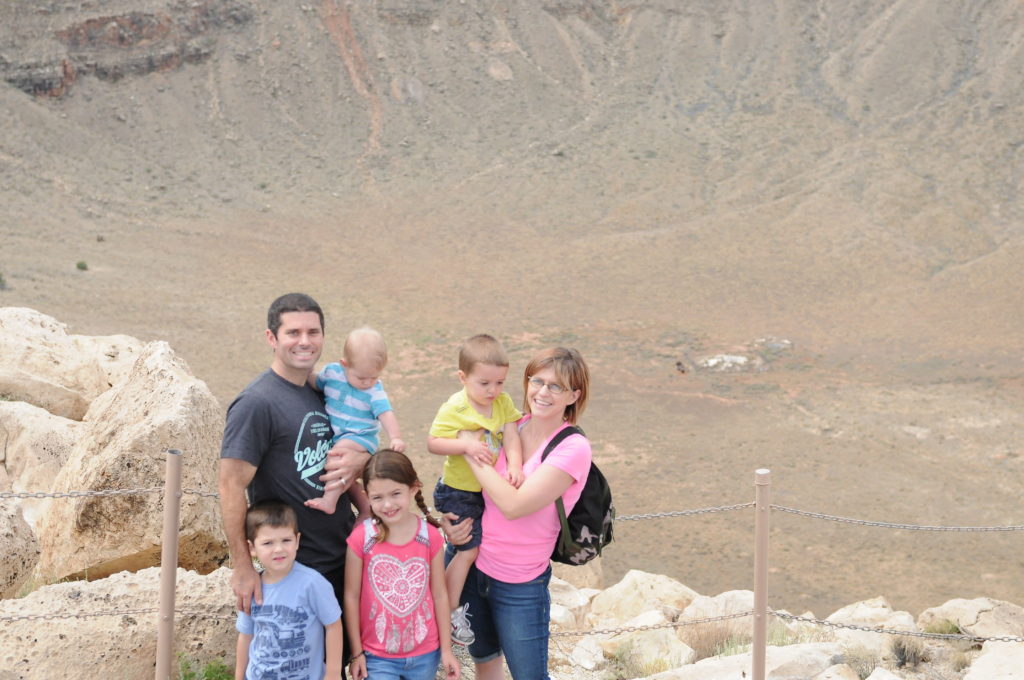
Now imagine the size and power of a similar eruption coming out of the ground and leaving behind a crater, instead of a cone, that has a diameter of 3,891’. That is the diameter of the Arizona Hydrocrater. Many still call this desert phenomenon, located near Winslow, Arizona, the Arizona Meteor Crater. Being able to walk the crater rim was another amazing family trip we’ve taken.

Hydrofountains
Hydrofountains were the main source of water during the Universal Flood. Genesis 7:11 reads, “In the six hundredth year of Noah’s life, in the second month, the seventeenth day of the month, the same day were all of the fountains of the great deep broken up, and the windows of heaven were opened.”
The UMs definition of a hydrofountain is “a phreatic eruption of superheated water ranging in size from small to extremely large.” The geysers at Yellowstone are SMALL hydrofountains. The Arizona Hydrocrater would be the result of a large hydrofountain. As the crust of the Earth became unstable during the Universal Flood, frictional heating of underground water caused the Earth’s crust to erupt leaving craters in many places of the world. The same process of frictional heating also explains how most of the craters on the Moon were formed.
Hydrofountains On One of Saturn’s Moons
Speaking of moons. In 2005, the Cassini spacecraft captured the eruption of several hydrofountains erupting together on one of Saturn’s moons, Enceladus. Check it out here. Enceladus’ crust is heated by the gravitational pull of Saturn. The eruption spewed water into space at a distance greater than the entire diameter of Enceladus.

Bigger Than a Hydrofountain
Mt Saint Helens is an extremely large hydrofountain or in other words a hydrovolcano. It was mostly steam, dust and superheated water that came out when it last erupted in 1980. Mt Pinatubo in the Philippines is also an example of a hydrovolcano.
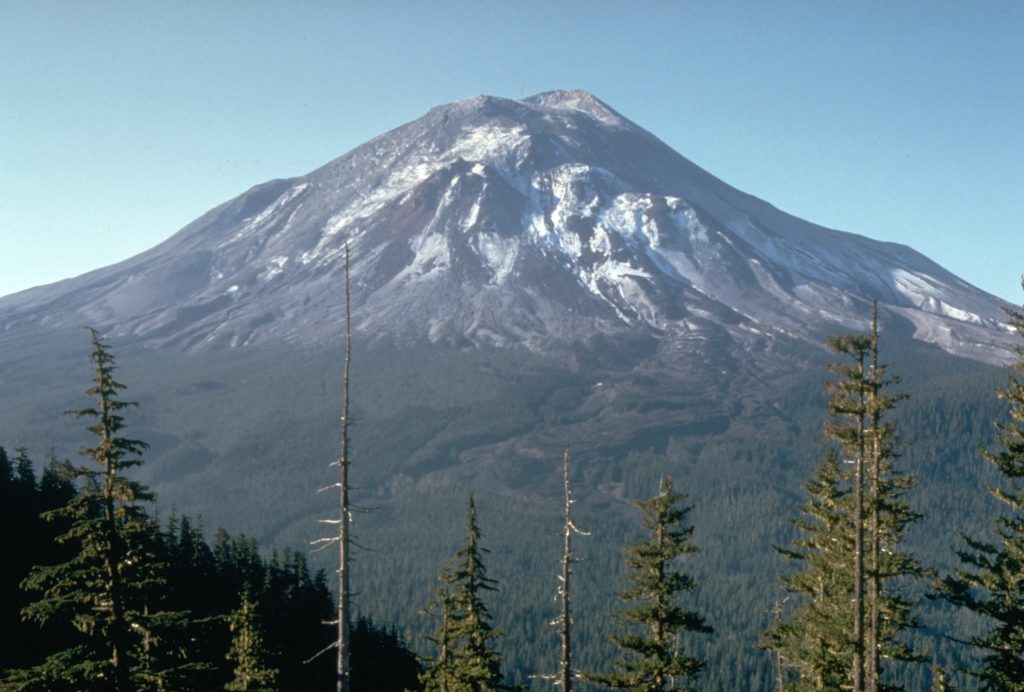
Mt St Helens – Day Before 1980 Eruption 
Mt St Helens – One Day After Eruption
As fascinating as it would be to witness one of these catastrophic and erratic eruptions up close, I’ll stick to the enjoyment of hard benches, ice cream and Old Faithful in Yellowstone National Park.