On 10 Jan, 2019
 Science is a beautiful thing. It is how we obtain an understanding of the Universe and a comprehension of how it works. We base our questions on our own personal experiences with Nature. As we follow the Universal Scientific Method (USM) we obtain answers to those questions which increases our knowledge and wisdom. This typically leads to more questions if we accept what Nature is telling us.
However, some scientists get stuck on the theory and, believing it to be true despite the failed experiments and lack of evidence, begin to teach it as if it was true. They then begin to create other theories based on the assumed truth of a false theory. One of the greatest pseudotheories, a false theory taught as fact, of all time is the Magma Pseudotheory.
A whole chapter in the UM is dedicated to the Magma Pseudotheory. It is the first major pseudotheory taught because once the fact that it is a pseudotheory is understood, new major scientific laws can be discovered. Scientists and researchers are beginning to recognize this fact but it will take more time before it is universally accepted.
There are dozens of pseudotheories based on magma, however, I would like to point out four basic pseudotheories, that are presented in the Universal Model, that seem to get a lot of attention in modern science. They are Bowen’s Reaction Series Pseudotheory, Magma Convection Pseudotheory, Mantle Plume Pseudotheory, and Magma-based Tectonic Plate Pseudotheory.
Bowen’s Reaction Series Pseudotheory
Bowen’s Reaction Series Pseudotheory, by Norman L. Bowen (1887-1956), was based on experiments and theories of James Hall (1761-1832), who based his experiments and theories on James Hutton (1726-1797). James Hutton became known as the ‘father’ of modern geology.
“…Hutton proposed that granite had formed from a hot molten material that solidified deep in the Earth. The evidence was conclusive, as no other explanation could accommodate all the facts.”
Understanding Earth – Second Edition: Frank Press, Raymond Siever, W.H. Freeman and Company, 1998
However, we read that…
“Hutton disliked experimentation and was a great skeptic of experimental methods in general.”
Melting the Earth, The History of Ideas On Volcanic Eruptions: Haraldur Sigurdsson, Oxford University Press, 1999
Bowen’s experiments were based on the false idea that the Earth became a sphere because it was once a liquid ball of magma. From this molten sphere, it was believed that igneous rocks, such as granite and basalt, came from the melted rock which crystallized as it cooled.
Wikipedia has this to say about Bowen and his experiments.
“He experimented in the early 1900s with powdered rock material that was heated until it melted and then allowed to cool to a target temperature whereupon he observed the types of minerals that formed in the rocks produced. He repeated this process with progressively cooler temperatures and the results he obtained led him to formulate his reaction series which is still accepted today as the idealized progression of minerals produced by cooling basaltic magma that undergoes fractional crystallization.”
Ask any geology professor if they have seen granite form from a melt. You won’t meet one because no one has. I once asked a retired geology professor from ASU this. His reply was, “Although I have not seen granite form from a melt I have in fact seen microscopic crystals form as melted rock cooled.”
The crystals formed throughout granite can be seen with the naked eye. You don’t need a microscope to see that there are quartz crystals all throughout it
Although some journal articles will imply that Bowen’s ideas panned out in the laboratory, the fact remains that granite did not come from a melt.
A few years ago I was able to melt granite and basalt with Dean Sessions. When it cooled it looked nothing like it did before.
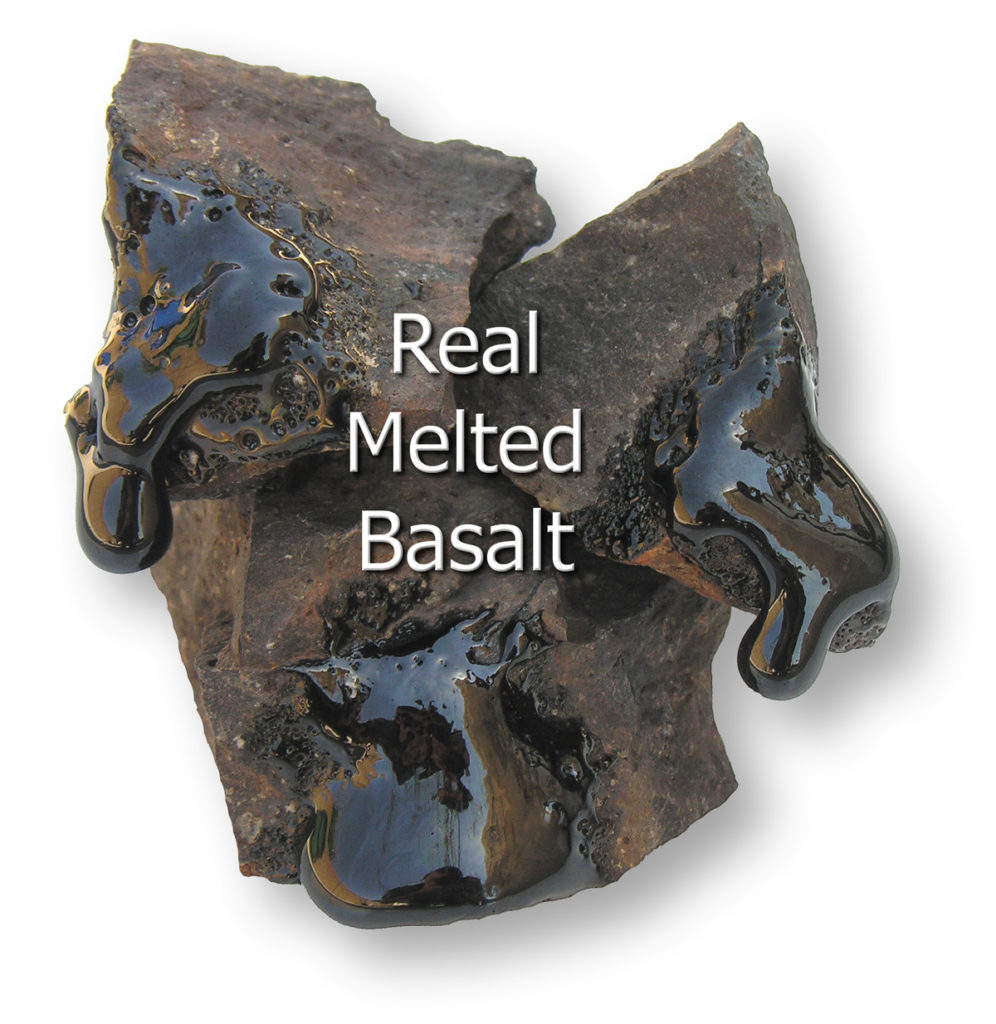

Modern Science will need another way to explain how granite and basalt is made.
Magma Convection Pseudotheory
Convection is the process in which materials mix together as they heat and cool. Heated material will move away from a heat source. Cooler material will move toward the heat source. Something I remember doing when I was a kid and wondering why it did that was the little black pieces floating in the melted wax of a candle. I would sit for long periods of time watching this process. Pieces of the burnt wick always seem to fall into the melted wax of a burning candle. As the wax heats up you will see the movement of it because of the little black pieces. They seem to be attracted to the flame. As soon as they get close to the flame they seem to jump from it. This is a small example of convection going on in the wax.

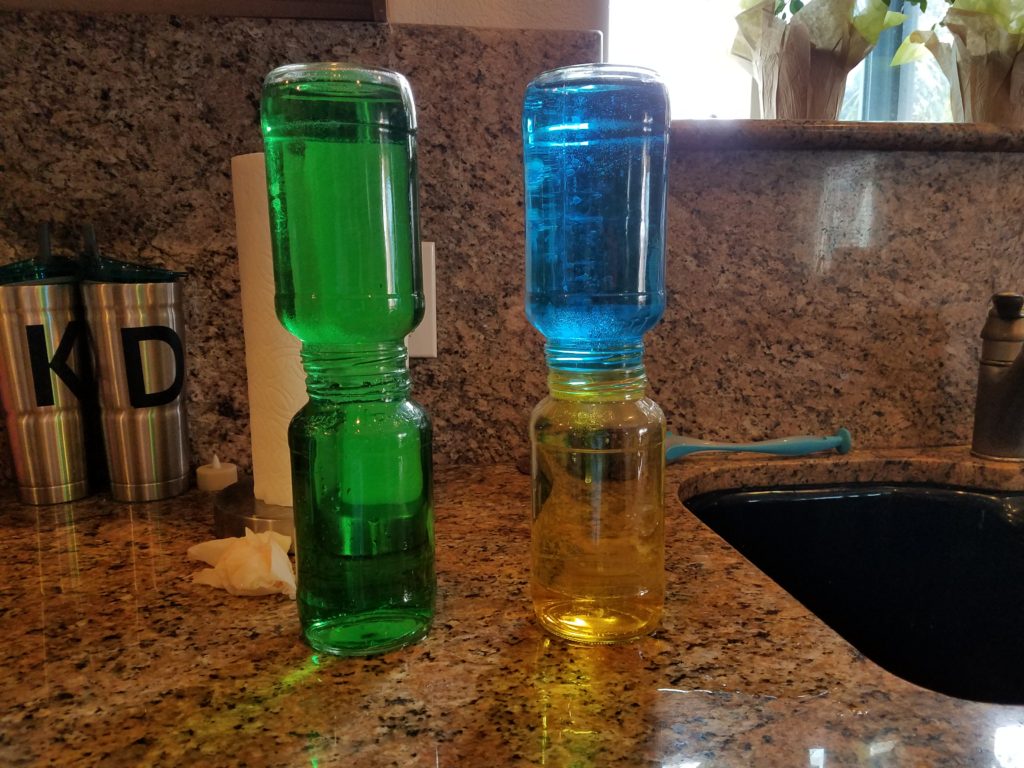
I did an experiment with a group of kids in March of last year. Heated molecules always rise because they are less dense than cooler molecules. To test this we filled two glass jars with hot water and two with cold water. We put food coloring in to help us remember which jars were hot (blue) and which were cold (yellow). Next, we took the jar with hot water (blue), using a playing card as a lid to keep the water from spilling out, tipped it over and set it on top of the jar with cold water. After that we slowly removed the playing card from between the two jars. The water seemed to seal itself in the jars. We then observed to find that the hot water stayed in the jar on top and the cold water stayed in the jar at the bottom. They did not mix except just a tiny bit where they came together at the two openings. Next we placed the jar with cold water (yellow) in it on top of the jar with hot water (blue). We removed the playing card from between them. At what seemed at an instant, the hot water began rising into the jar on top and the cold water began sinking into the jar on the bottom. It only took about 30 seconds for the water in both jars to turn green which is the color that blue and yellow makes when mixed together.
Homemade chocolate chip cookies, made by my wife of course, are my favorite type of cookie to eat when I’m not training for a race. It’s fascinating to watch all of the ingredients go into the mixer separately only to have them uniformly combined after just a minute or so of mixing.
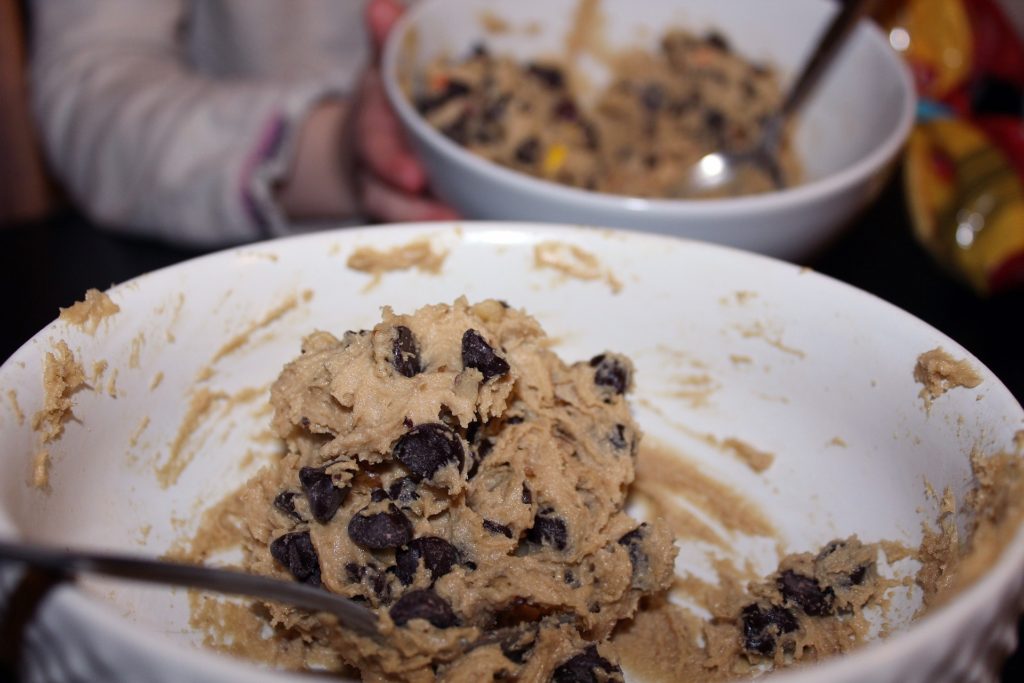
From my observations I can mix things together and only through a very controlled and tedious process can I separate them apart.
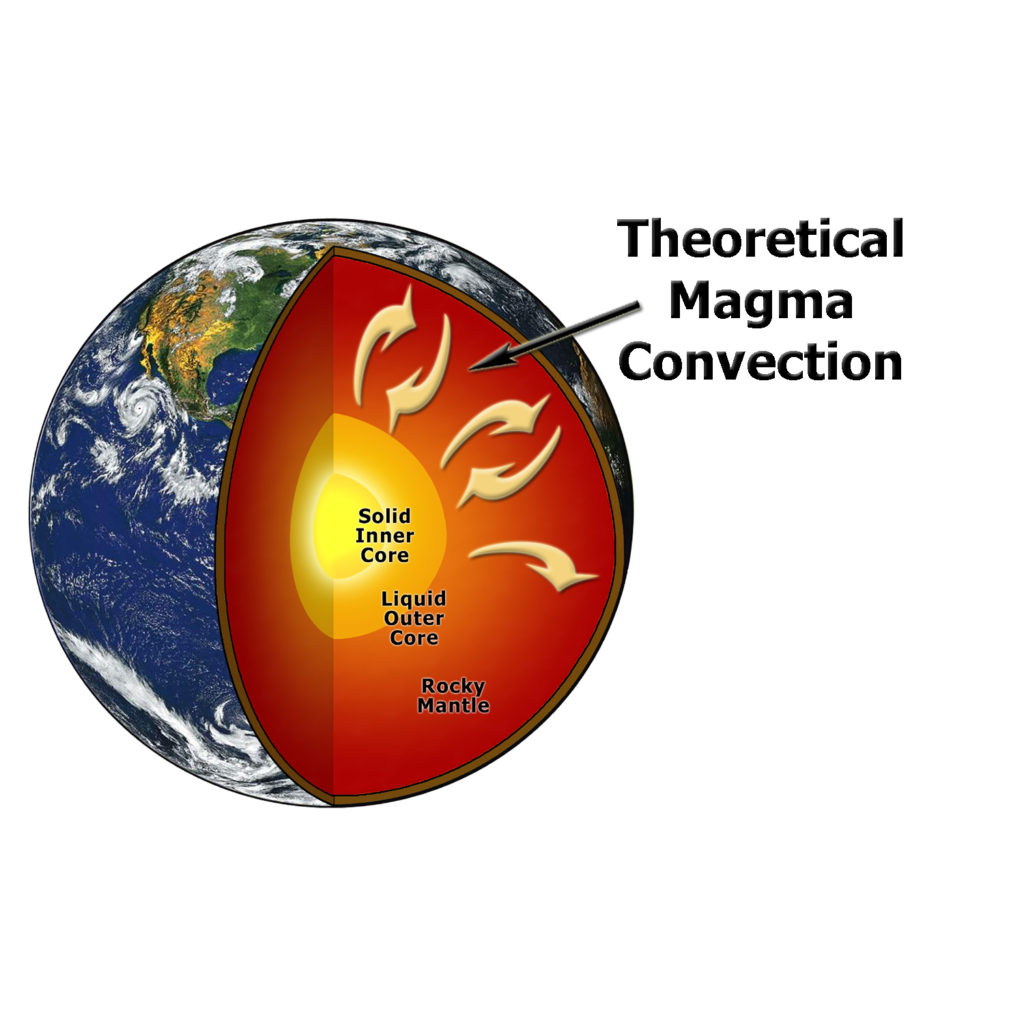
This creates a problem with the magma convection process. It is believed that the center of the Earth is hot and is also where the heat source for the assumed molten rock in the mantle is. If that were true then we would actually see the convection process working on magma in the mantle. Hot molten rock is less dense than cool solid rock. The hot molten rock will rise toward the surface of the Earth while the cooler rock will then sink to the center of the Earth where it’s supposed to be hotter. Do this for 4.5 billion years and it should have all mixed together right? Based on some observations in Hawaii this is not so. Researchers tested the chemical composition of lava around the islands. They discovered that they were not the same; that they were actually of different chemical compositions. They published their findings in Science, in June, 2000.
“The second major question is how the differing chemical compositions of erupted magmas, which, require several chemically distinct reservoirs within the mantle, can be reconciled with other observational and dynamical constraints favoring whole-mantle convection, which should mix chemical heterogeneities.”
Mantle Convection and Plate Tectonics: Toward an Integrated Physical and Chemical Theory, Paul J Tackley, Science, Vol. 288, 16 June 2000 p2002
Scientists found two types of lava only miles apart. If whole-mantle convection has been occurring for the last 4.5 billions years we should see a very similar type of lava when compared to anywhere in the world let alone only miles apart in Hawaii..
Modern Science will need another way to explain mantle plumes.
Mantle Plume Pseudotheory
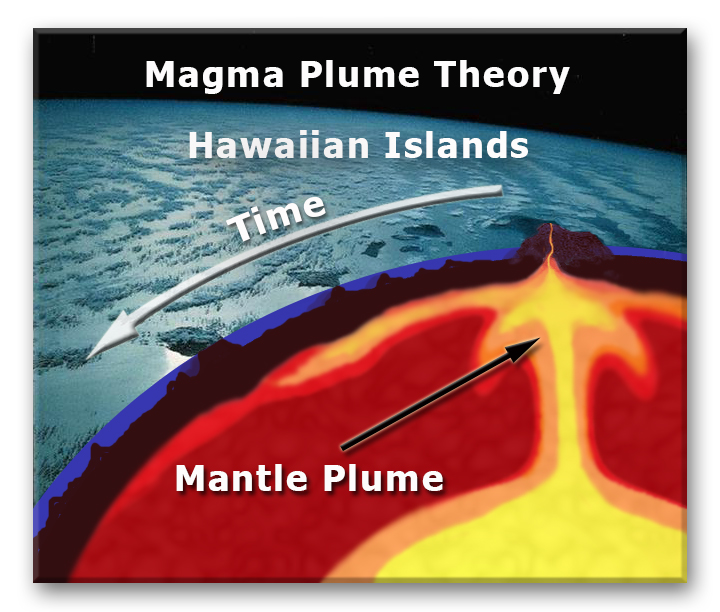
Mantle plumes are believed to be generated because of the convection process. However, if you read through a few science journals based on Modern Science you will notice that mantle plumes are just a theory. No one has ever observed them. That’s easy for someone that already understands that magma is just a theory but what about the person that was taught in school that magma and magma plumes are real? From the article: The question of mantle plumes we learn from scientists and researchers that they are just an assumption, not an observation.
“Although Morgan initially presented mantle plumes as an assumption, over time, the fact that they were an assumption — not an observation — has been forgotten, Foulger says. No plume has yet been found to satisfy all the criteria currently attributed to plumes, she says, adding that the hypothesis has become too flexible, with ad hoc variations tacked on to accommodate any finding.”
https://www.earthmagazine.org/article/question-mantle-plumes
“‘You just have to keep making up excuses and modifications to make plume theory work,’ says Foulger”
Volcanic Bombshell, Nicola Jones, New Scientist, 8 March 2003, p37
Modern Science will need to come up with another way to explain plate tectonics. It is believed that the movement of magma in the mantle, convection, is why the continents are moving, some away from each other and others toward each other and overlapping.
Magma-Based Tectonic Plate Pseudotheory
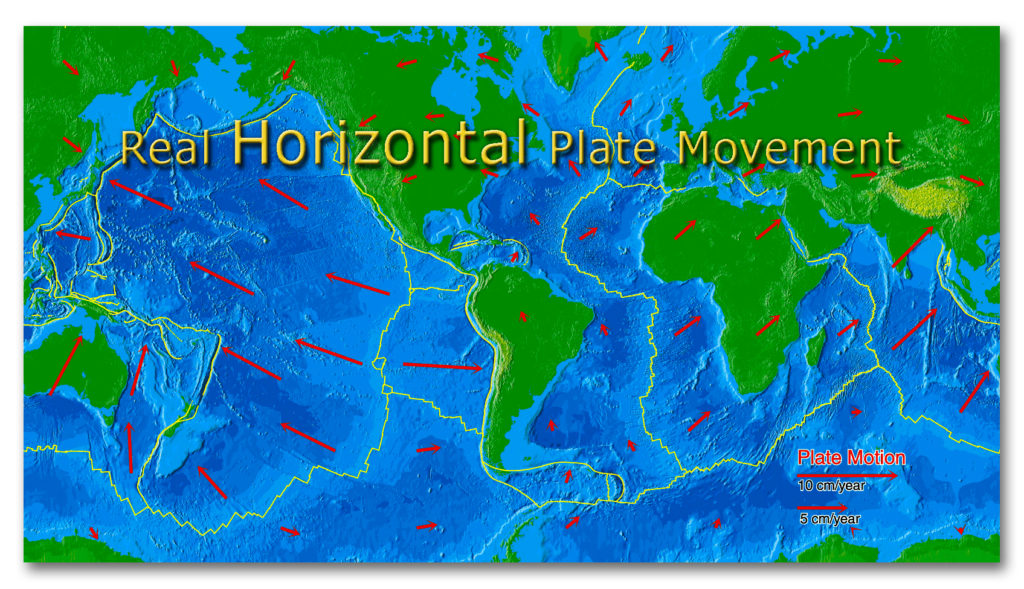
Aside from the Bible teaching that the continents drifted apart 200 years after the Universal Flood, Alfred Wegener proposed, in 1912, the idea that the continents are drifting horizontally around the Earth. His hypothesis was controversial and not widely accepted until the 1950s when technology advanced enough to make the observations needed to prove that the continents are, in fact, drifting.
This is where Modern Science based a theory (plate tectonics) on a false theory (magma). A new scientific law will never be discovered when a theory is based on a false theory. They believe the mechanism or the reason the continents are drifting is because of magma convection and magma plumes underneath them. The continents are in fact drifting a few to several centimeters every year, however, it is not because of magma convection.
Without magma there is no magma convection or magma plumes. A new mechanism is needed to explain why the continents are drifting. To discover this mechanism a new paradigm is needed.
The Universal Model gives us a clue as to what this new paradigm is by restating “first-order questions” in the article Mantle Convection and Plate Tectonics: Toward an Integrated Physical and Chemical Theory, Paul J. Tackley, Science, Vol. 288, 16 June, p2002. “First-order questions” are basically “Fundamental Questions” or FQs found throughout the Universal Model.
“The first of these is why Earth developed plate tectonics at all, given that other terrestrial planets such as Mars and Venus do not currently exhibit this behavior.”
Knowing where something came from, or why it is there in the first place, helps us to understand its mechanisms. Modern Science will always have difficulty explaining the creation of anything in the Universe because of the belief of the Big Bang, which is that everything came from nothing. The Big Bang is pseudotheory.
The reason why Mars and Venus do not show plate tectonics occurring on them is answered in Chapter 5.14 of Vol. I The Earth System of Universal Model.
“The answer to the question as to why Mars and Venus do not exhibit plate tectonics has much to do with the gravitational force of a large moon, which neither of them has. We can better understand the workings of the Earth’s plates by examining Jupiter’s moon, Io, the most volcanically active planetoid in the entire solar system with over 400 active volcanoes. Io is a violent example of the Gravitational Friction Law at work. Io, the closest of Jupiter’s Galilean moons, endures tidal forces that cause its surface to rise and fall by 100 meters every Ioan day as it turns on its axis. Likewise, the Earth’s relatively large moon generates a lot of tidal activity, and there are dozens of earthquakes occurring somewhere on the Earth at all times. Mars has two small moons and Venus has no moon, so neither planet feels the gravitational pull-and-tug that the Earth and Io experience. This is the primary reason why the Earth’s two neighboring planets exhibit no tectonic activity.”
Modern Science already acknowledges that the continents are floating on a liquid. It is Millennial Science that gives us the true answer, WATER.
Our continents used to be one super continent called Pangea. It was because of the Universal Flood that it was broken apart. There is overwhelming evidence proving that our continents were once one big continent. These range from fossils to geological structures found on the coastlines of neighboring continents.
The Earth’s continents, that are floating on water, are moving horizontally because of the gravitational forces of the Moon and Sun.
Any theory that is based on the Magma Pseudotheory will fail because a theory based on a false theory will never lead to a new natural law.
As you learn more and more about the extraordinary evidence found all over the world that the Earth actually formed from water and NOT from a melt you will also come to discover dozens of new natural laws and hundreds of extraordinary claims already demonstrated in the Universal Model. One of which, that is discussed in other blog posts, is that there truly was a Universal Flood that covered all of the land masses on Earth in about 2,345 B.C.
A correct theory that is based on the process of experimentation and observation, will always lead to the discovery of new natural laws. (USM)